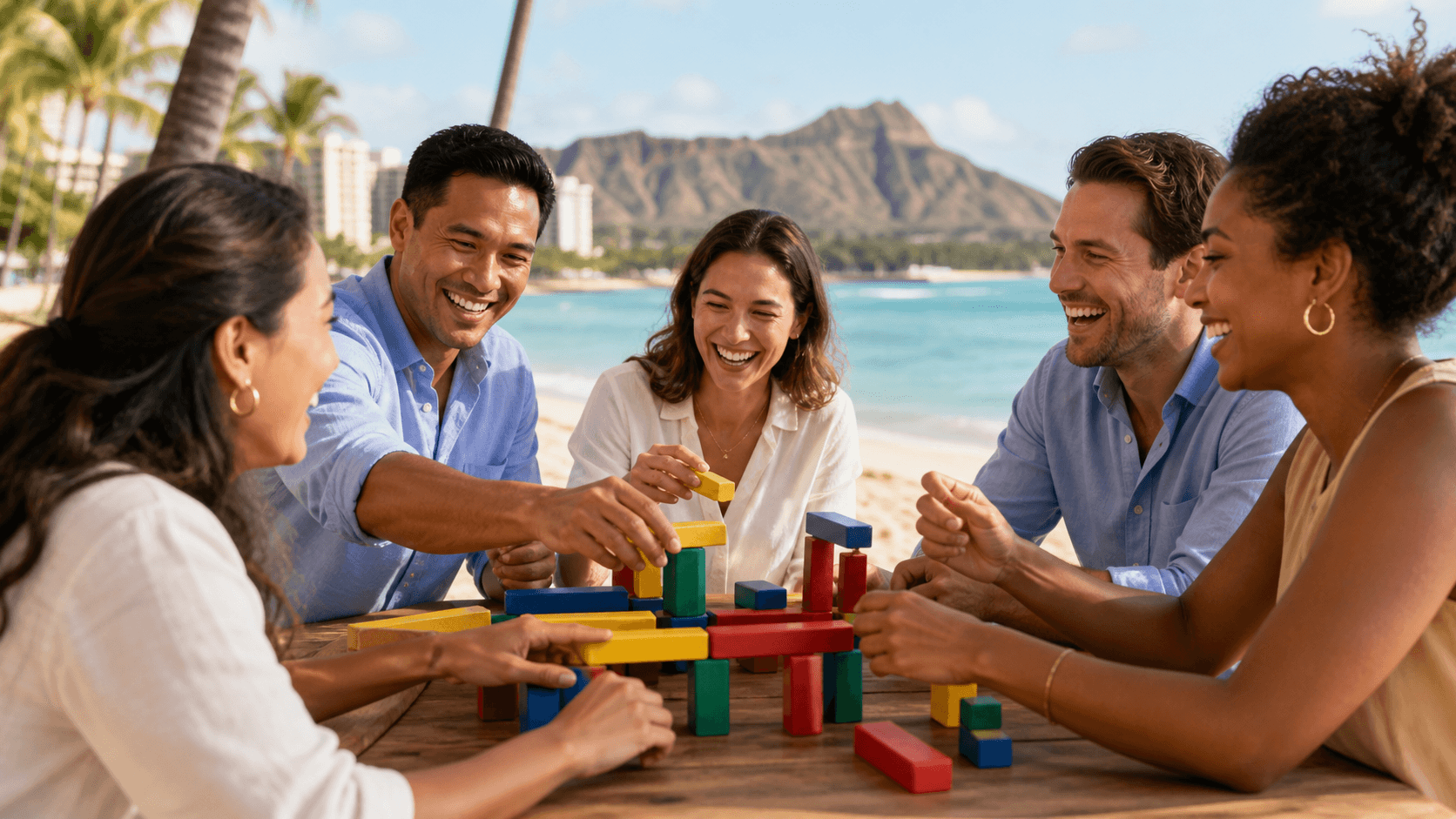
Corporate training usually has a good starting point. It gives teams a way to learn the basics of communication, tasks, or processes. But if you've ever walked out of a training room and felt like nothing really changed, you're not alone. That's because what happens in the room doesn't reflect what actually happens day-to-day on a team.
Team behavior is shaped by mood, pace, people, and the space around them. In Honolulu, where the sunlight stretches longer into the evening and team energy softens in late summer, the way people show up to work is rarely steady. Traditional corporate training doesn't make room for that. But team building superpowers do. They help us see how behavior shifts naturally, not just under stress but with season, timing, and rhythm. Real teamwork means knowing how people move together, not just how they follow instructions.
How Teams Interact Outside the Classroom
Most corporate training happens in quick bursts, maybe a day-long workshop or a short series of sessions. That kind of setup works well for rules and structure. But it struggles to hold the slower, smaller changes that happen between the lines of actual work.
- We often see how Fire can come in fast and bold during a meeting, then fade just as quickly in a quiet planning session. Metal might stay rigid under deadlines but soften once there's space to breathe. These shifts never show up during training sessions because those sessions are too short to catch them.
- Behavior isn't frozen in one spot. It moves across the day and across a week. Fire energy might get louder in the morning and burn out by afternoon. Water might not speak at all during group time but show up powerfully one-on-one.
- When we focus only on what happens in the training room, we miss most of what's shaping the group. Real team understanding needs time and space, not just tips and worksheets.
If we only train for the moment in the room, we're practicing for something that isn't really work.
Energy Mismatches Are Often Overlooked
Many team challenges come from mismatched energy, not miscommunication. But corporate training programs often treat all people the same. They teach everyone to talk through conflict, give feedback, and follow process without space to look at how different energies move differently through those same experiences.
- Water energy, for example, slows things down until it makes sense. Wood energy often charges forward with a step-by-step plan. These behaviors can look like disagreement or even resistance if no one points out what's really going on.
- Teams end up stuck. People start assuming the worst. "She's dragging her feet." "He doesn't care what others think." In truth, team members may just be showing different superpowers during a shared experience.
- Time is the quiet teacher here. Unless training lets people see each other across weeks, those mismatches go unresolved.
Without a way to name energy differences, teams keep circling the same tension without knowing why. Group performance suffers not from a lack of instruction, but from a lack of shared insight.
Why Seasonal Shifts Matter in Places Like Honolulu
As we move into September, Honolulu begins to slow slightly. The late-summer warmth lingers, but routines begin to shift. Outdoor breaks get longer. Calendars feel less jammed. That rhythm shows up in work, too.
- Earth and Water energies often grow stronger this time of year, bringing more reflection, more quiet checking in, and slower decisions. This mood is rarely captured in training programs that expect year-round pace and focus.
- Fire might burn less brightly, and Metal might take longer to restart after a slower weekend. Real team behavior flows with the season, especially in places like Honolulu where buying into the weather is part of how people live.
- Corporate training isn't built to respond to sunlight, air, or tilt in pace. But those factors shift a team's feel more than any slide presentation can.
When we ignore season and location, we miss what teams are feeling. Energy awareness brings that space back into view.
Missing the Role of Shared Energy Language
Some teams spend years learning to work together. Others find their rhythm fast. What makes the difference isn't just skill, it's whether team members have a shared way to talk about what's happening.
- Without common language, people guess. Was that person being sharp, or are they showing Metal during stress? Is someone checked out, or is their Fire pulsing low today?
- Corporate training often teaches general communication messages like "be clear," "listen more," or "stay open." Those are helpful, but they don't go deep. They don't show us how to read the space between words.
- Naming your own superpower in a meeting, "I'm in Wood today, wanting to move fast," gives your team more context. Recognizing a co-worker's Earth energy lets you pause instead of pushing.
When we build teams around a shared energy lens, we start to move together instead of working around each other. That's when collaboration feels natural.
Stronger Teams Start With What's Already There
Workplace behavior isn't built by bullet points. It grows through mood, trust, habit, and rhythm. Honolulu's steady light and layered pace shape those experiences, even when no one's formally leading a session.
- Teams don't need someone else's strategy to improve. They need honesty about what's happening now, today, in their specific room, with these exact people.
- Superpowers help teams tune into patterns. When we stop expecting everyone to behave the same way every day, what at first feels like unpredictability becomes a kind of clarity. We see what's really driving the group.
- Instead of guessing what the team needs, we learn to ask. We step in instead of pulling away. We build trust by responding to the energy in front of us, not a theory.
When we start from real behavior, not ideals or instruction, we get closer to how work actually feels. And that's where the real progress starts.
Unlock the potential of your team beyond traditional methods with Master Your Superpowers. Our approach to corporate training embraces the unique energy rhythms present in your workplace, fostering genuine interaction and collaboration. By understanding the natural flow of your team's dynamic, especially here in Honolulu, you can transform the way your team works together. Let's explore what truly makes your group tick and build a more connected and resilient team today.